 by Teva
AI Agents vs Traditional Automation: What’s the Difference?
Businesses are constantly looking for ways to improve productivity, reduce operating costs, and deliver better customer experiences. As technology continues to evolve, automation has become an important part of achieving these goals. However, a new development is changing how businesses approach everyday tasks: artificial intelligence (AI) agents. Understanding AI agents vs traditional automation can help business owners choose the right technology for their operations, whether they manage a startup, a growing company, or a large enterprise.
Traditional automation has helped businesses complete repetitive tasks for years, while AI agents introduce a more flexible approach to solving problems and making decisions. Although both technologies can save time and improve efficiency, they work differently. The right choice depends on the complexity of your processes, your budget, and the results you want to achieve.
What Is Traditional Automation?
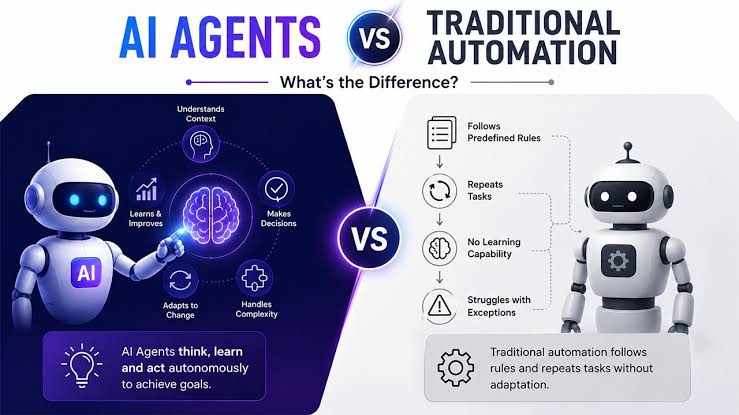
Traditional automation uses predefined rules, instructions, and workflows to perform specific tasks without requiring constant human involvement. Once a system is configured, it follows the programmed instructions whenever the appropriate conditions are met. This makes it useful for processes that are repetitive, predictable, and consistent.
For example, a payroll system can calculate employee salaries based on approved working hours, tax rules, and deductions. Similarly, an e-commerce platform can automatically send order confirmations after customers complete their purchases. These processes demonstrate how AI agents vs traditional automation differ in their approach to handling business operations.
Traditional automation works best when the steps required to complete a task are clearly defined. It can reduce human error, improve consistency, and free employees to focus on more valuable responsibilities. However, when an unexpected situation occurs outside its programmed rules, the system may require human intervention or additional development before it can respond appropriately.
What Are AI Agents?
AI agents are software systems that use artificial intelligence to understand objectives, evaluate information, make decisions, and take actions toward achieving specific goals. Depending on their design and permissions, they may use large language models, business data, APIs, and external tools to complete tasks that involve multiple steps.
Consider a customer who contacts a business with a complicated complaint. An AI agent could interpret the customer’s message, review relevant order information, identify possible solutions, and prepare an appropriate response. If authorized, it could also initiate a refund request or update a customer relationship management system. This practical example illustrates the difference between AI agents vs traditional automation.
Unlike conventional rule-based systems, AI agents can handle some situations that were not explicitly anticipated during development. They can also use feedback and available context to adjust their approach. Nevertheless, their decisions are not always correct, and their performance depends on the quality of their models, data, tools, and instructions. Human oversight remains essential for sensitive or high-impact decisions.
AI Agents vs Traditional Automation: Key Differences
Although both technologies aim to improve efficiency, their capabilities differ in several important areas.
Decision-Making
Traditional automation follows predefined rules. For instance, a system may approve an order automatically when the payment is confirmed and the required conditions are satisfied.
AI agents can evaluate context and choose among possible actions based on their objectives, available information, and configured constraints. This makes AI agents vs traditional automation particularly relevant when businesses need systems that can handle complex requests rather than simply follow fixed instructions.
Flexibility and Adaptability
Traditional automation performs reliably when processes remain consistent. However, changes to business rules or unusual situations may require developers to update workflows.
AI agents can interpret varied inputs and adjust their actions within their capabilities. A customer support agent, for example, may understand different ways customers describe the same problem. Even so, adaptability does not mean unlimited independence; AI agents still require clear boundaries, testing, and monitoring.
Task Complexity
Traditional automation is effective for structured tasks such as sending invoices, generating reports, processing routine payments, and scheduling reminders.
AI agents are more suitable for certain tasks involving research, interpretation, planning, and multiple connected actions. When comparing AI agents vs traditional automation, businesses should consider whether the process requires flexible reasoning or simply reliable execution of established instructions.
Human Involvement
Traditional systems usually require developers or administrators to define workflows and maintain their rules. Once established, routine tasks can run automatically.
AI agents may independently complete several steps within an approved workflow, but employees should supervise important decisions, review unusual outcomes, and intervene when necessary. The appropriate level of human involvement depends on the risks associated with the task.
Benefits of AI Agents for Businesses
AI agents can help businesses improve customer service, support employees, analyze information, and coordinate workflows across different applications. For example, an AI sales assistant may qualify incoming leads, summarize customer interactions, and recommend follow-up actions to a sales representative.
Another advantage is their ability to work with unstructured information, including emails, documents, and customer messages. Understanding AI agents vs traditional automation helps organizations identify opportunities where flexible interpretation can complement existing systems.
However, AI agents are not automatically better for every business process. They may introduce additional expenses, require access to sensitive data, and produce inaccurate results. Businesses should begin with clearly defined use cases and measurable performance targets before expanding their deployment.
Benefits of Traditional Automation
Traditional automation remains valuable because it is predictable, efficient, and often easier to test. Businesses can use it to process routine transactions, calculate totals, validate forms, send notifications, and maintain standardized records.
For tasks with clear rules, traditional automation can be less expensive to operate than an AI-powered alternative. It may also offer greater consistency because the system follows established instructions instead of generating context-dependent responses. Therefore, evaluating AI agents vs traditional automation should involve the cost, reliability, and complexity of each specific task.
For example, a company does not necessarily need an AI agent to send an email whenever a customer completes a purchase. A simple automated workflow can perform that task effectively without the additional complexity of an AI model.
How Much Does It Cost to Implement These Technologies?
The cost of implementation depends on the project’s scope, software requirements, integrations, security needs, and ongoing maintenance.
Traditional automation projects may cost approximately $500–$5,000 for relatively simple workflows, while more complex business process automation can cost $5,000–$30,000 or more. These are illustrative planning estimates rather than fixed market prices.
AI agent development may cost approximately $3,000–$15,000 for a relatively focused solution, while sophisticated systems with multiple integrations, advanced security, custom data pipelines, and enterprise requirements can exceed $20,000–$100,000. Ongoing expenses may include model usage, cloud hosting, monitoring, and technical support.
When budgeting for AI agents vs traditional automation, businesses should compare the total cost of ownership rather than the initial development fee alone. A lower-cost solution may be sufficient for a simple process, while a more advanced system may justify its expense if it delivers measurable improvements in productivity or service quality.
Can Businesses Combine AI Agents and Traditional Automation?
Yes. In many cases, combining both technologies offers a practical approach. Traditional automation can manage predictable steps, while AI agents handle tasks that require interpretation or more flexible decision-making.
For example, an online retailer could use an AI agent to interpret customer enquiries and determine the appropriate next step. Traditional automation could then update the order status, send a notification, or record the interaction in the company’s database.
This hybrid approach to AI agents vs traditional automation allows businesses to benefit from AI capabilities without replacing every established workflow. It can also make systems easier to control by assigning routine operations to deterministic processes and limiting AI decision-making to suitable tasks.
How to Choose the Right Solution
Before investing in either technology, businesses should identify the process they want to improve and assess its complexity, frequency, risks, and expected return.
Choose traditional automation when tasks are repetitive, rules are clear, and outcomes must remain consistent. Consider AI agents when work involves interpreting language, gathering information, handling variations, or coordinating multiple actions.
A thoughtful assessment of AI agents vs traditional automation should also consider data privacy, access permissions, system integration, error handling, and human oversight. Testing a small project before expanding it can help an organization understand the technology’s actual value.
Frequently Asked Questions
Are AI agents better than traditional automation?
Not always. AI agents are useful for tasks involving interpretation and flexible decision-making, while traditional automation is often better for predictable, rule-based processes. The best choice depends on the business objective and operational requirements.
Can AI agents replace existing business software?
AI agents can extend existing software by connecting to approved applications and performing selected tasks. However, they do not necessarily replace the underlying systems that manage payroll, inventory, payments, or customer records.
Is traditional automation cheaper than AI agents?
Traditional automation is often less expensive for straightforward tasks because it does not require AI model usage. However, the overall cost depends on development, maintenance, integration, and the complexity of the process.
How can Techvantage Innovations help businesses implement automation?
Techvantage Innovations can help businesses assess their requirements and develop suitable software solutions, including custom business applications, workflow automation, API integrations, and AI-powered systems. The appropriate solution depends on each organization’s goals, infrastructure, and budget.
Conclusion
Understanding AI agents vs traditional automation is essential for businesses that want to improve efficiency without investing in unnecessary technology. Traditional automation remains an excellent option for repetitive, rule-based activities, while AI agents offer additional capabilities for tasks requiring interpretation, planning, and flexible responses. Combining both can create a more effective technology strategy.
The most important step is to identify your business needs, evaluate the available options, and choose a solution that delivers measurable value. Whether you need custom business software, automated workflows, AI integration, or a scalable digital platform, reach out to Techvantage Innovations to discuss your requirements and build a technology solution that supports your business growth.