 by Teva
How Businesses Can Integrate AI Into Existing Enterprise Software
Businesses are constantly looking for ways to improve productivity, reduce operational costs, and deliver better customer experiences. One technology making this possible is Artificial Intelligence (AI). Instead of replacing their entire technology infrastructure, organizations can introduce intelligent features into their existing enterprise software to improve how their systems operate. This approach allows businesses to modernize their operations while retaining valuable data, established workflows, and familiar applications.
Integrating AI into existing enterprise software can help organizations automate repetitive tasks, analyze large volumes of information, detect unusual activities, and make better business decisions. From financial institutions and retail companies to healthcare providers and manufacturing businesses, AI offers practical opportunities to improve efficiency and remain competitive in a digital economy.
What Does AI Integration Mean for Enterprise Software?
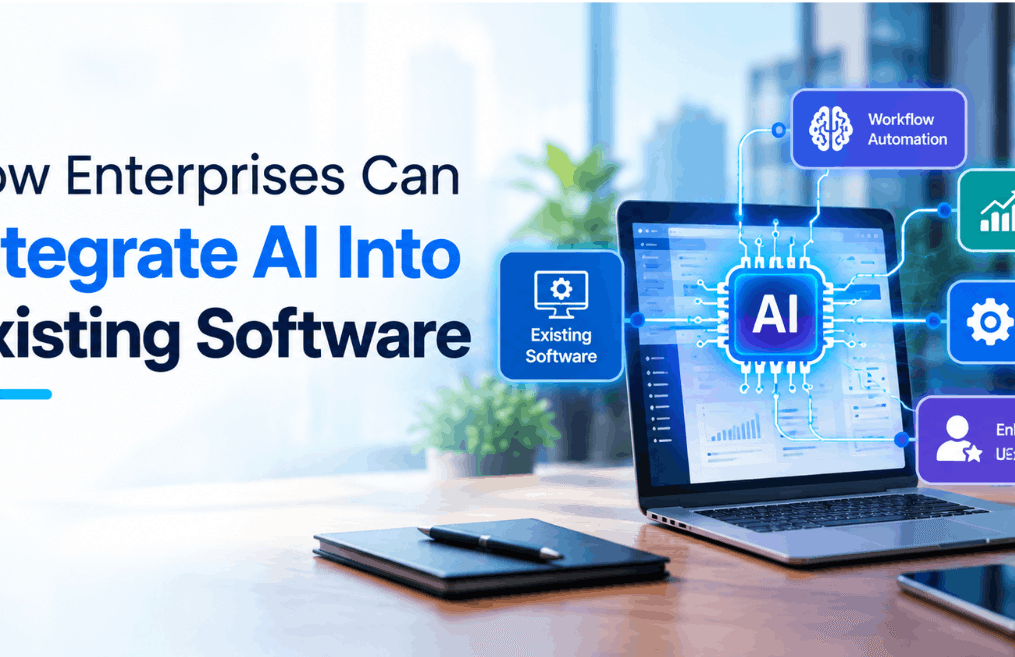
AI integration involves adding artificial intelligence capabilities to business applications that are already in use. Rather than developing an entirely new system, companies can enhance their current technology with machine learning, natural language processing, predictive analytics, and intelligent automation.
For example, a company using existing enterprise software to manage customer relationships could integrate an AI assistant that recommends relevant products, answers common questions, and identifies potential sales opportunities. Similarly, an accounting platform could use AI to flag unusual transactions and automate invoice processing.
The objective is to make business applications more intelligent, responsive, and efficient without unnecessarily disrupting daily operations.
Why Should Businesses Integrate AI Into Their Existing Systems?
Organizations often invest significant time and money in their software infrastructure. Replacing these systems can be expensive, disruptive, and difficult to justify when the technology still meets essential operational requirements. Enhancing existing enterprise software with AI provides a practical alternative for businesses seeking innovation without starting from scratch.
Several benefits make this approach attractive:
- Improved productivity: AI can automate repetitive administrative activities, allowing employees to focus on strategic responsibilities.
- Better decision-making: Intelligent analytics can identify patterns and trends that may not be immediately visible in conventional reports.
- Reduced operational costs: Automation can minimize manual errors, unnecessary delays, and duplicated work.
- Enhanced customer experience: AI-powered recommendations and chatbots can provide faster, more personalized support.
Greater scalability: Businesses can introduce intelligent capabilities gradually as their needs and resources grow.
These benefits depend on selecting suitable AI applications, maintaining accurate data, and aligning implementation with measurable business objectives.
Identify Business Processes That Need AI
Successful AI adoption begins with understanding the organization’s challenges. Before modifying existing enterprise software, management should identify processes that consume excessive time, generate frequent errors, or require employees to analyze large amounts of information manually.
For instance, a human resources department may spend hours reviewing applications, organizing employee records, and responding to routine enquiries. AI can assist with document classification, employee self-service, and workforce reporting. A sales team may benefit from predictive lead scoring, while a logistics company could use AI to forecast demand and optimize delivery schedules.
Businesses should prioritize use cases with clear benefits, accessible data, and manageable implementation requirements. Starting with one well-defined problem makes it easier to evaluate performance before expanding the project.
Assess Software Compatibility and Data Quality
Before integrating AI, organizations must understand their current technology infrastructure. Existing enterprise software may rely on legacy databases, older programming languages, proprietary interfaces, or third-party applications that require additional integration work.
A technical assessment should examine system architecture, application programming interfaces (APIs), database structures, security controls, and available computing resources. This evaluation helps developers determine whether AI functionality can be added directly or whether middleware and supporting services are necessary.
Data quality is equally important. AI models depend on relevant, accurate, and sufficiently representative information. Incomplete customer records, inconsistent financial entries, and duplicated documents can reduce the reliability of AI-generated results. Businesses should therefore clean, organize, and validate their data before deployment.
Choose the Right AI Technologies
The best technology depends on the organization’s objectives and the capabilities of its current applications. Integrating AI into existing enterprise software does not necessarily require building a machine learning model from the ground up.
Common technologies include:
Machine learning: Useful for predicting customer behaviour, estimating demand, detecting fraud, and identifying operational patterns.
Natural language processing: Enables applications to understand, classify, and generate human language for customer support, document analysis, and internal search.
Generative AI: Helps employees summarize reports, draft documents, retrieve information, and interact with business knowledge through conversational interfaces.
Robotic process automation: Automates repetitive, rule-based tasks, while AI can add capabilities such as document interpretation and intelligent classification.
Predictive analytics: Uses historical and current data to forecast business outcomes and support planning.
Organizations may use cloud-based AI services, open-source models, or custom-built solutions. The choice should reflect budget, security requirements, data sensitivity, performance expectations, and long-term maintenance needs.
Integrate AI Through APIs and Middleware
APIs provide a common way for different applications to exchange information. Developers can use them to connect existing enterprise software with AI models, cloud services, document-processing tools, and analytics platforms.
For example, an enterprise resource planning system could send selected inventory data to an AI service that forecasts future demand. The resulting prediction could then appear inside the application’s existing dashboard, helping managers make informed purchasing decisions.
Middleware can also connect systems that cannot communicate directly. However, integration should include authentication, access controls, error handling, data validation, and monitoring to prevent unreliable information from moving between applications.
Businesses should avoid granting AI services unrestricted access to sensitive databases. Instead, they should provide only the information and permissions required for each task.
Protect Business Data and Maintain Compliance
Security must remain a priority throughout AI implementation. Connecting existing enterprise software to external AI platforms can introduce risks involving confidential documents, customer information, financial records, and intellectual property.
Companies should assess how AI providers store, process, and retain submitted data. They should implement encryption, role-based access controls, audit logs, secure API authentication, and appropriate data-retention policies. Sensitive information should be minimized or anonymized where practical.
AI outputs also require appropriate oversight. An automated system may generate inaccurate recommendations, misclassify records, or produce convincing but incorrect information. Human review is particularly important for decisions involving financial approvals, employment, legal obligations, and customer eligibility.
Organizations operating in regulated industries should evaluate applicable data protection requirements and maintain documentation of their AI systems, including their intended purposes and limitations.
What Is the Cost of AI Integration?
The cost of integrating AI into existing enterprise software varies according to system complexity, data readiness, security requirements, and the sophistication of the desired features. Businesses should evaluate the total cost of implementation rather than focusing exclusively on development fees.
Indicative planning estimates in US dollars include:
- Basic AI integration:$5,000–$15,000 for a relatively straightforward feature using an existing AI service.
- Intermediate integration:$15,000–$50,000 for multiple workflows, custom APIs, testing, and dashboard enhancements.
- Advanced enterprise integration:$50,000–$150,000 or more for complex systems, specialized models, extensive data pipelines, and enterprise-grade security.
These figures are illustrative estimates, not fixed market prices or quotations. Actual costs can fall outside these ranges depending on the project scope and location of the development team.
Additional expenses may include AI API usage, cloud hosting, data preparation, employee training, security assessments, ongoing monitoring, and software maintenance. Businesses should begin with a defined budget, measurable objectives, and a realistic estimate of the expected return on investment.
Test, Deploy, and Continuously Improve
AI integration should follow a structured implementation process. Rather than introducing new capabilities across every department at once, businesses can test a limited application with a selected group of users.
A typical process involves requirements analysis, system assessment, data preparation, AI selection, development, integration testing, security validation, user acceptance testing, and deployment. After launch, developers should monitor accuracy, response times, operating costs, user adoption, and business outcomes.
When AI is added to existing enterprise software, organizations must also establish procedures for handling failures, updating models, reviewing unexpected outputs, and responding to changes in business requirements.
Feedback from employees and customers can reveal where the system needs improvement. Regular evaluation helps ensure that AI remains useful, reliable, and aligned with the organization’s objectives.
How Can Techvantage Innovations Help?
Businesses need a technology partner that understands software architecture, application integration, data management, and the practical demands of enterprise operations. Techvantage Innovations provides software development and technology services designed to help organizations build, improve, and scale their digital solutions.
When modernizing existing enterprise software, businesses can benefit from services such as custom software development, API integration, database development, cloud services, cybersecurity, mobile application development, and AI-powered application development. These capabilities can support the creation of solutions that work with existing business processes rather than forcing organizations to replace every established system.
A structured engagement should begin with a technical assessment, followed by a clear implementation plan, defined deliverables, testing, deployment, and ongoing support. This approach helps businesses manage technical risks while creating opportunities for future innovation.
Frequently Asked Questions
Can AI be added to software that is several years old?
Yes. AI can often be integrated into older existing enterprise software through APIs, middleware, database connections, or carefully designed supporting services. However, compatibility and security assessments are necessary to determine the most suitable approach.
Will integrating AI require replacing our current software?
Not necessarily. Many AI projects enhance current applications without replacing their core functionality. Replacement may be appropriate if the underlying system is obsolete, insecure, or too difficult to maintain.
How long does AI integration take?
A simple implementation may take several weeks, while a complex enterprise project may require several months or longer. The timeline depends on data readiness, system complexity, testing requirements, and the number of workflows involved.
Is AI integration suitable for small businesses?
Yes. Small businesses can start with affordable AI services for customer support, document processing, sales analysis, and workflow automation. A focused implementation can provide value without requiring a large enterprise-wide investment.
How can businesses measure the success of AI integration?
Businesses can track measurable indicators such as processing time, operating costs, error rates, customer satisfaction, employee productivity, and revenue generated. These indicators should be established before deployment to support meaningful evaluation.
Conclusion
Integrating AI into existing enterprise software allows businesses to modernize their operations, improve productivity, strengthen decision-making, and deliver better customer experiences without automatically replacing their entire technology infrastructure. Success depends on identifying the right use cases, preparing quality data, selecting suitable AI technologies, protecting sensitive information, and monitoring performance after deployment.
As artificial intelligence continues to evolve, organizations that adopt a strategic and responsible approach will be better positioned to respond to changing market demands. Businesses seeking reliable software development, AI integration, and digital transformation support should reach out to Techvantage Innovations to discuss their requirements and develop solutions aligned with their operational goals, budget, and long-term growth plans.